
PIONEERING ZERO-WATER, ZERO-DISCHARGE
PLASTIC VALORIZATION
Patented indigenous thermo-mechanical engineering by Founder Francis Kunhipalu Vareed converting non-recyclable multi-layered plastics (MLP) and single-use plastics (SUP) directly into 50+ year structural infrastructure assets.
WHY CONVENTIONAL RECYCLING FAILS ON MLP, SUP, RDF & PLA
Multi-Layer Flexible Packaging (MLP) — used in snack, chips, biscuit, and confectionery wrappers — consists of micro-thin bonded layers of Polyethylene (PE), Polypropylene (PP), Polyester, and Aluminium foil printed with chemical inks.
Coupled with Single-Use Plastics (SUP), Refuse-Derived Fuel (RDF), and Polylactic Acid (PLA) carry bags, these polymers fail conventional mechanical recycling. Because they melt at wildly different temperatures and cannot be separated economically, over 90% is dumped in landfills, incinerated in cement kilns, or burnt openly, creating toxic air emissions.
The GEOWASOL Paradigm Shift
Rather than attempting costly chemical peeling or water washing, GEOWASOL utilizes a patented thermo-mechanical fusion matrix that homogenizes mixed municipal polymers directly under high temperature and mechanical shear, locking the plastic permanently into an impervious composite.
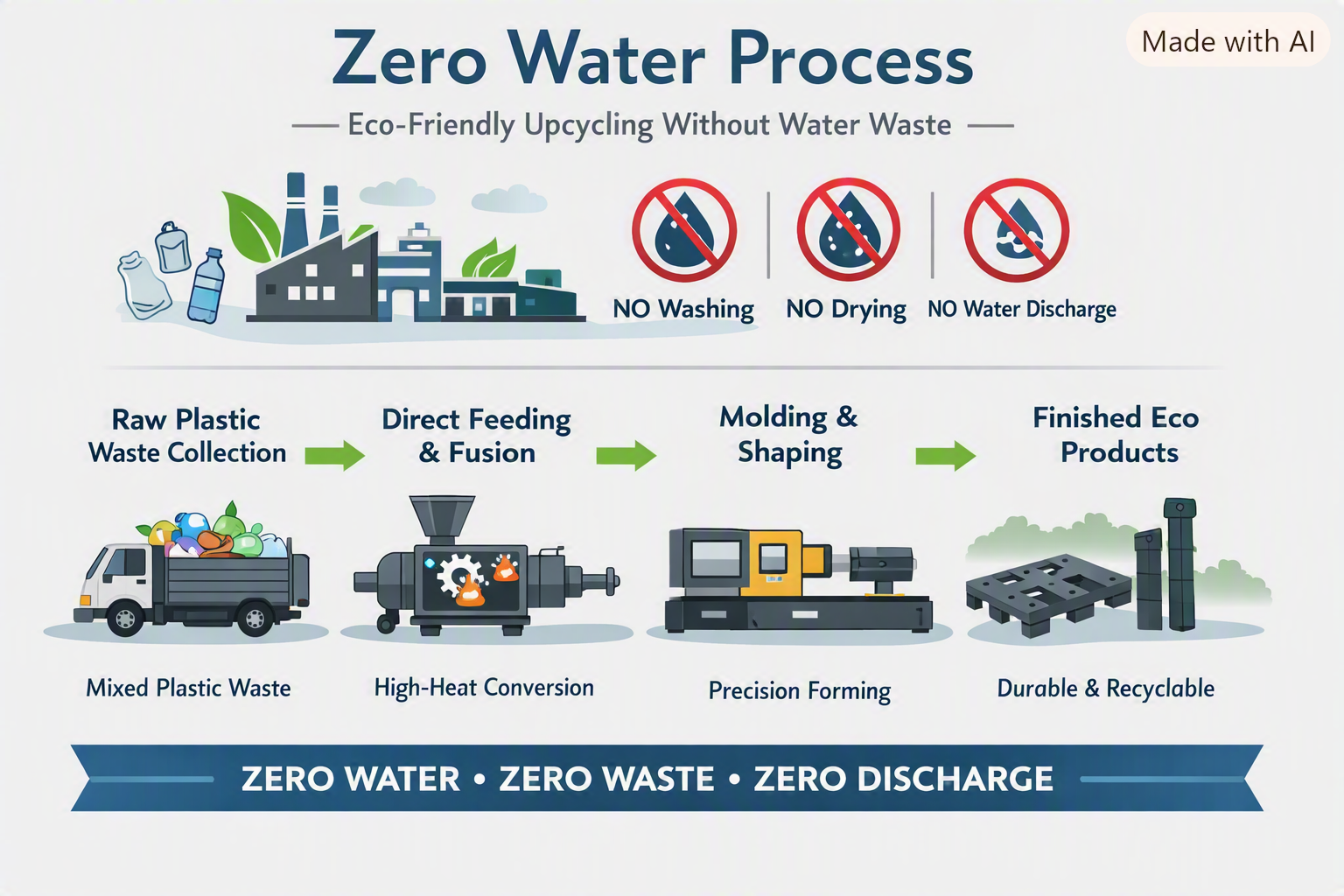
Upcycling MLP, SUP, RDF & Non-Recyclable PLA Carry Bags Into Hybrid Polymer Composites
We can upcycle and convert not only MLP & SUP (Snack, nuts, popcorn, biscuits, chips, food wrappers and all other crisp packets metallised and nonmetallised & single use plastic) but also RDF & PLA (Refuse-Derived Fuel & Polylactic Acid carry bags — which are non recyclable) into Hybrid Polymer Composite to make pallets and allied products.
Polylactic Acid (PLA) is a biodegradable thermoplastic polyester derived from renewable resources like corn starch, cassava roots, or sugarcane. While commercially positioned as an eco-alternative, discarded PLA carry bags cannot be degraded in municipal conditions and ruin standard mechanical recycling batches due to thermal degradation. GEOWASOL's thermo-mechanical fusion encapsulates PLA alongside multi-layered packaging and high-energy RDF, locking them into ultra-dense, termite-proof, waterproof composite pallets and allied structural goods.
THE 3T CONCEPT: TRANSLATE • TRANSFORM • TRANSACT
GEOWASOL’s breakthrough methodology replaces conventional Reduce, Recycle, Reuse with an industrial value-addition paradigm driven by S.M.A.R.T. Technology:
• S – Sensor-Based Sorting |
• M – Mechanical Optimization |
• A – Automated Processing |
• R – Resource |
• T – Technique
All mixed waste plastics (MLP, SUP, RDF, PLA) are translated into homogenous polymer composite feedstock without sorting or washing.
Feedstock is transformed into high-density 39.67 MPa structural composites via continuous multi-zone thermo-mechanical fusion.
Transacting finished pallets, trellis posts, and tiles into high-margin industrial and municipal supply chains.
THE 4-STAGE ZERO WATER VALORIZATION PIPELINE
How GEOWASOL turns municipal plastic waste into industrial infrastructure without using a single drop of process water.
Raw Waste Intake (MLP, SUP, RDF, PLA)
Accepts snacks & crisp packets (metallised/non-metallised), single-use plastics, Refuse-Derived Fuel (RDF), and non-recyclable PLA bags without sorting.
Direct Thermo-Mechanical Feed
Waste enters the custom processing unit directly. Skips water cleaning, skips hot air drying tunnels, and eliminates all chemical detergent pre-treatments.
MECHFUSO & HTMS Fusion
Proprietary thermo-mechanical fusion binds the multi-layered polymer matrices together, producing exceptional certified compressive strength of 39.67 MPa (ASTM D695).
Closed-Loop Compression
Formed into heavy pallets, agricultural posts, or interlocking pavers. Off-cuts and damaged units are reground back into the system with zero residual waste.
THE SCIENCE OF THERMO-MECHANICAL FUSION
Conventional recyclers fail because PE, PP, PET, and metallized aluminium foil have conflicting melt indices and phase boundaries. Attempting to melt them conventionally causes thermal degradation, toxic gas emissions, and brittle structural failure.
GEOWASOL’s proprietary continuous thermo-mechanical shear matrix homogenizes heterogeneous polymers under controlled thermal zones without chemical degradation. The continuous polymer chain physically encapsulates the aluminium foil particles and printing inks, turning them into reinforcing structural micro-fillers rather than contaminants.
Foil and mineral pigments are locked permanently into the polymer core, enhancing compressive load capacity.
Precision temperature profiling prevents hydrocarbon burning, producing no toxic dioxins or emissions.
ENGINEERING TEST DATA & MECHANICAL BENCHMARKS
Independently tested mechanical parameters conforming to global testing frameworks (ASTM D695, ASTM D790 / D7264, and ASTM D638).
Outperforms treated timber (30–35 MPa) and mid-grade structural concrete. Prevents buckling under heavy canopy and harvester loads.
Provides the necessary yield point to deflect under extreme gusts and lateral crop weight without permanently snapping or cracking.
2,000–2,500 MPa sweet spot: stiff enough to stand straight under tension, elastic enough to deflect on tractor impact and spring back.
Optimized for composite profiles primarily subjected to flexural bending and axial compression without excess material expense.
| Performance Parameter | GEOWASOL Patented Hybrid | Treated Hardwood | Reinforced Concrete (RCC) | Virgin Synthetic FRP / PVC |
|---|---|---|---|---|
| Certified Compressive Strength (ASTM D695) | 39.67 MPa (Certified) | 30 – 35 MPa | 25 – 35 MPa | 18 – 22 MPa (PVC) / 150+ MPa (FRP) |
| Flexural Strength (ASTM D790 / D7264) | 24 – 30 MPa | 40 – 50 MPa | 3 – 5 MPa (Brittle) | 35 – 45 MPa (PVC) / 100–300 MPa (FRP) |
| Flexural Modulus / Stiffness | 2,000 – 2,500 MPa (2.0–2.5 GPa) | 8 – 12 GPa | 20 – 30 GPa (Rigid/Shatters) | 2.5 – 3.2 GPa (PVC) / 10–20 GPa (FRP) |
| Tensile Strength (ASTM D638) | 9 – 13 MPa (Optimized) | 10 – 20 MPa | 2 – 4 MPa | 30 – 40 MPa (PVC) / 200+ MPa (FRP) |
| Operational Lifespan | 50+ Years (Guaranteed) | 3 – 7 Years (Decays) | 10 – 15 Years (Cracks) | 5 – 10 Years (PVC Brittle) |
| Water Absorption & Leaching (ASTM D570) | 0.0% (Zero Absorption) | 15 – 35% (Swells) | 5 – 10% (Porous) | 0.1% |
| Termite & Insect Resistance | 100% Impervious | High Susceptibility | Immune | Immune |
| Chemical & Fertilizer Resistance | Impervious to Fertilizer & Acid | Rotting / Degrades | Corrosion by Acids | Moderate |
| End-of-Life Circularity | 100% Recyclable / Buyback | Burned or Landfilled | Crushed Landfill Waste | Hard to Recycle |
Mechanical Performance of Patented Hybrid Polymer Composite Profiles
The mechanical performance metrics of profiles manufactured via our patented technology conform to and surpass global engineering standards for agricultural trellis posts, composite structural profiles, and specialized industrial piping. The baseline testing aligns with standard global frameworks: ASTM D695 (Compressive), ASTM D790 / ASTM D7264 (Flexural), and ASTM D638 (Tensile).
Compressive Strength (39.67 MPa) — Excellent
Traditional wooden trellis posts typically fail at 30–35 MPa under compression. Our hybrid polymer significantly outperforms standard treated timber and is comparable to mid-grade structural concrete. It safely prevents posts from buckling under heavy crop loads or mechanical harvesting vibration.
Flexural Strength (24 – 30 MPa) — Standard & Well-Accepted
In agricultural applications, wind loads and heavy vine fruit pull posts sideways. A flexural strength of 24–30 MPa provides the necessary yield point to bend slightly under extreme wind without permanently snapping, delaminating, or cracking.
Tensile Strength (9 – 13 MPa) — Typical for Eco-Hybrids
A range of 9–13 MPa is completely normal and optimal for hybrid polymer profiles using co-extruded natural fibers, fillers, and recycled commodity thermoplastics. For trellis profiles subjected mostly to flexure and compression, this rating fully meets operational duty while keeping cost low.
Flexural Modulus / Stiffness (2,000 – 2,500 MPa) — Optimal Sweet Spot
Translates to 2.0 to 2.5 GPa. This is the recognized classic "sweet spot" for agricultural profiles. It is stiff enough to stand straight under tension, but retains the elastic flexibility to deflect under tractor impact or severe storms and bounce back to shape, unlike brittle concrete.
Manufactured using our proprietary patented hybrid polymer composite technology, these profiles offer an exceptional combination of mechanical strength, impact tolerance, environmental resistance, and economic feasibility. The empirical test data confirms that the product fully complies with international standards and meets the rigorous operational demands of the global agricultural, vineyard, and infrastructure industries.
WHY CONVENTIONAL GROUND-AND-PRESSED MLP SHEETS FAIL IN INDIA
The conventional sheet making process currently used in India for MLP and SUP is technically and commercially flawed, suffering from structural sagging, low efficiency, and high rejection. Discover how GeoWasol's continuous extrusion technology provides a proven, scalable alternative.
1. Creep & Continuous Load Sagging
Unlike plywood (which binds long, cross-grained wood fibers glued under tension), ground MLP boards are made of short, random plastic flakes with zero fiber matrix. Under continuous dead loads (shelves, partitions, benches), unlinked PE and PP molecules slowly slide past each other, causing permanent sagging within months.
2. Low Flexural Modulus & Heat Warping
Ground MLP sheets are flexible but have poor structural rigidity. When exposed to outdoor summer heat or roof installations, the mixed plastics soften at relatively low temperatures (60°C to 70°C), resulting in severe warping, bending, and wave distortion.
3. Brittleness & Screw Snapping
PET and aluminium foil layers from snack wrappers do not melt or blend with the PE/PP matrix. They act as internal structural contaminants, creating microscopic weak spots. When carpenters drive a screw near the edge or under sudden impact, the board snaps cleanly along unbonded boundaries.
4. Material Heterogeneity & Voids
Post-consumer MLP contains mixed polymers (LD, LLD, HD, PP, PO, PET, Nylon) with conflicting Melt Flow Indices (MFI). Conventional batch compression creates uneven bonding, surface mottling, and hidden structural voids that fail commercial mechanical inspections.
5. The Energy Cost Paradox
To hot-press a standard 4x8 ft sheet at 18mm thickness, factories must draw immense electrical power to heat steel molds past 180°C and cool completely under pressure to prevent warping. This repetitive heating-and-cooling cycle destroys commercial processing margins.
6. The Subsidy Trap & Labor Costs
Because carpenters reject heavy, brittle MLP sheets in the open market, surviving Indian plants operate only by fabricating niche CSR toilets or relying artificially on EPR credits (₹5–₹12/kg). Without true market demand, conventional sheet factories operate at continuous losses.
Benchmarking Conventional Sheets vs. GeoWasol Technologies
| Aspect / Metric | Conventional Sheet Making (India) | GeoWasol Continuous Sheet Making (Hybrid Polymer) | GeoWasol Pallet / Post Machinery (Hybrid Polymer) |
|---|---|---|---|
| 1. Production Volume | Low to medium (Batch hot-press heating/cooling bottleneck) | Very High — continuous plant design enables large-scale throughput | High — scalable machinery with proven industrial throughput |
| 2. Quality Standards | Below international benchmarks (Material heterogeneity, creep & snapping) | Superior — consistent homogeneous quality, internationally benchmarked | Meets international standards (39.67 MPa load, hygiene, 50+ yr lifespan) |
| 3. Applications | Limited to low-value partitions & subsidized public toilets | Specialized commercial plywood replacement, formwork, wall linings, cabinetry | Wide commercial demand: heavy pallets, agricultural trellis posts, fencing, pavers |
| 4. Sustainability & ROI | Poor — high energy consumption, dependent on artificial EPR subsidies | Strong — thermo-mechanical encapsulation, commercially viable, eco-friendly | Strongest — valorizes 100% MLP/SUP directly into high-value assets; ROI < 1 Year |
Conventional batch sheet presses in India yield low viability and poor financial returns. In contrast, GeoWasol Pallet & Post machinery offers high viability, wide market demand, and rapid commercial profitability. Where sheet formats are mandatory, our Continuous Hybrid Polymer Composite Sheet Line provides an advanced, internationally certified replacement that eliminates sagging creep and delivers superior structural integrity.
CERTIFIED ZERO EFFLUENT ENVIRONMENTAL CREDENTIALS
Eliminating millions of litres of industrial wastewater pollution and qualifying for national ESG carbon credits.
0 Litres Process Water
A 10 ton/day conventional plastic washing plant drains 100,000 litres of clean water daily. GEOWASOL consumes exactly zero litres, preserving precious ground water aquifers.
Zero Chemical Detergents
Eliminates sodium hydroxide, surfactants, and toxic chemical washing baths, preventing hazardous chemical sludge disposal in municipal environments.
ESG Carbon Neutrality
Diverts hard-to-recycle MLP plastic from landfill fires and cement kiln incineration, locking fossil-fuel carbon into durable 50+ year structural infrastructure.
PROVEN BY PATENTS, NATIONAL SEMINARS & MUNICIPAL ADOPTION
The proprietary zero-water valorization system was developed and patented by Founder Director Francis Kunhipalu Vareed and Co-Director Animma Francis, verified through rigorous independent institutional scrutiny, statutory patent grant under the Indian Patents Act 1970, academic seminar keynotes, and municipal field adoption.
Synergistic Polymer Composite & Method of Preparation
Official Title: "SYNERGISTIC POLYMER COMPOSITE AND A METHOD OF PREPARATION THEREOF FROM WASTE THERMOPLASTICS INCLUDING MULTILAYER FLEXIBLE-PACKAGING". Comprehensive protection for continuous thermo-mechanical fusion with zero effluent.
Design Registration No: 378014-001 (Class 25-01: Roof Tile)
Statutory registration under the Designs Act 2000 & Designs Rules 2001 in respect of composite geometric application to structural ROOF TILE in the name of M/S Geowasol Proteins & Polymers Private Limited.
CIPET National Polymer Seminar Keynote Address
Invited as keynote expert speaker and honored with official memento of recognition by Central Institute of Petrochemicals Engineering & Technology (CIPET) for pioneering zero-effluent thermo-mechanical composite processing.
Puttur CMC & Kolar Municipal Corporation Blueprints
Adopted in municipal technical seminars at Puttur CMC and engineered into comprehensive 100-cent circular waste valorization proposals for Kolar City Municipal Corporation, eliminating landfill dumping.
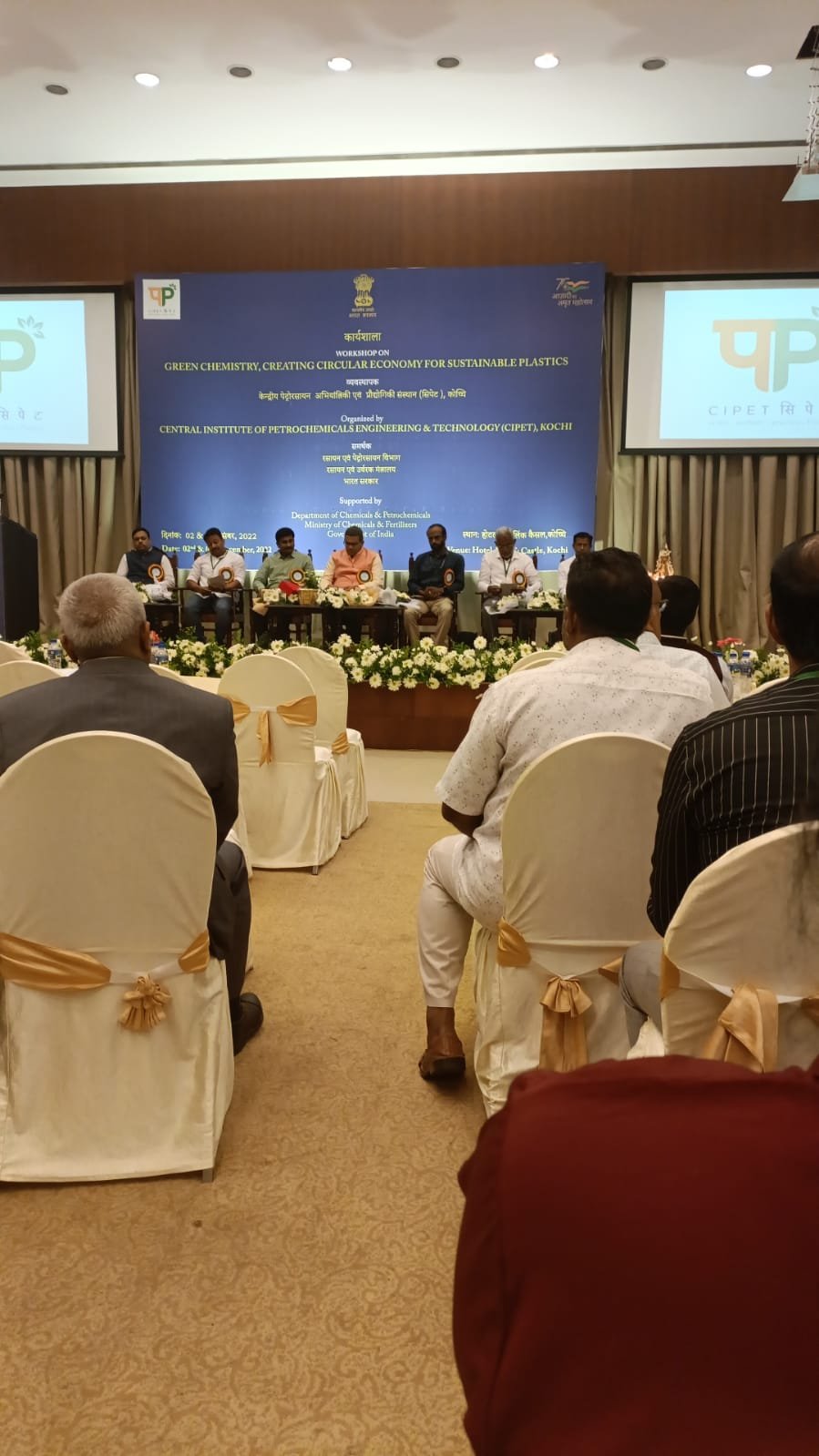
Founder Francis Kunhipalu Vareed presenting zero-water thermo-mechanical valorization of MLP plastics to scientists & petrochemical leaders.
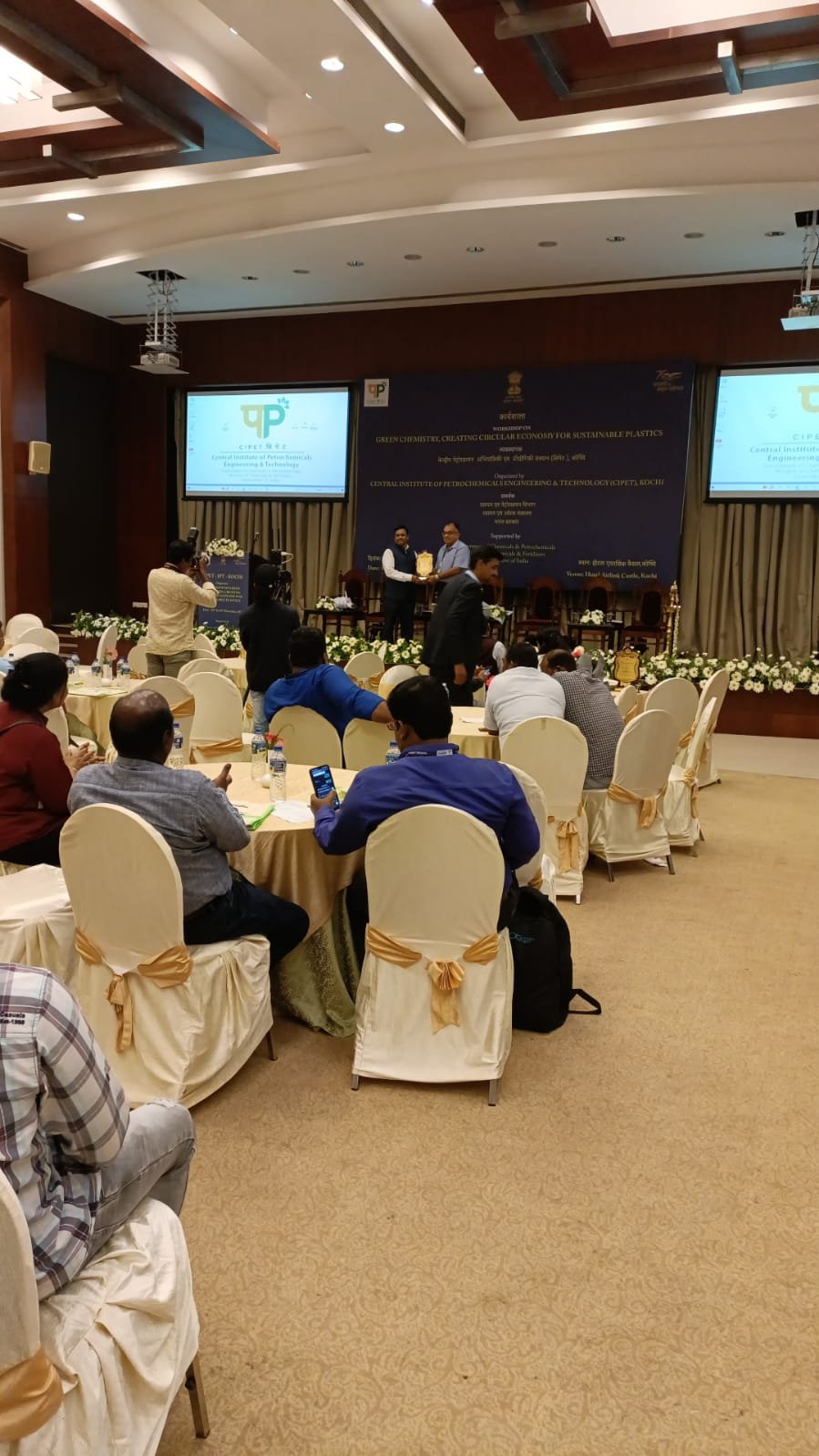
Presented by Central Institute of Petrochemicals Engineering & Technology.
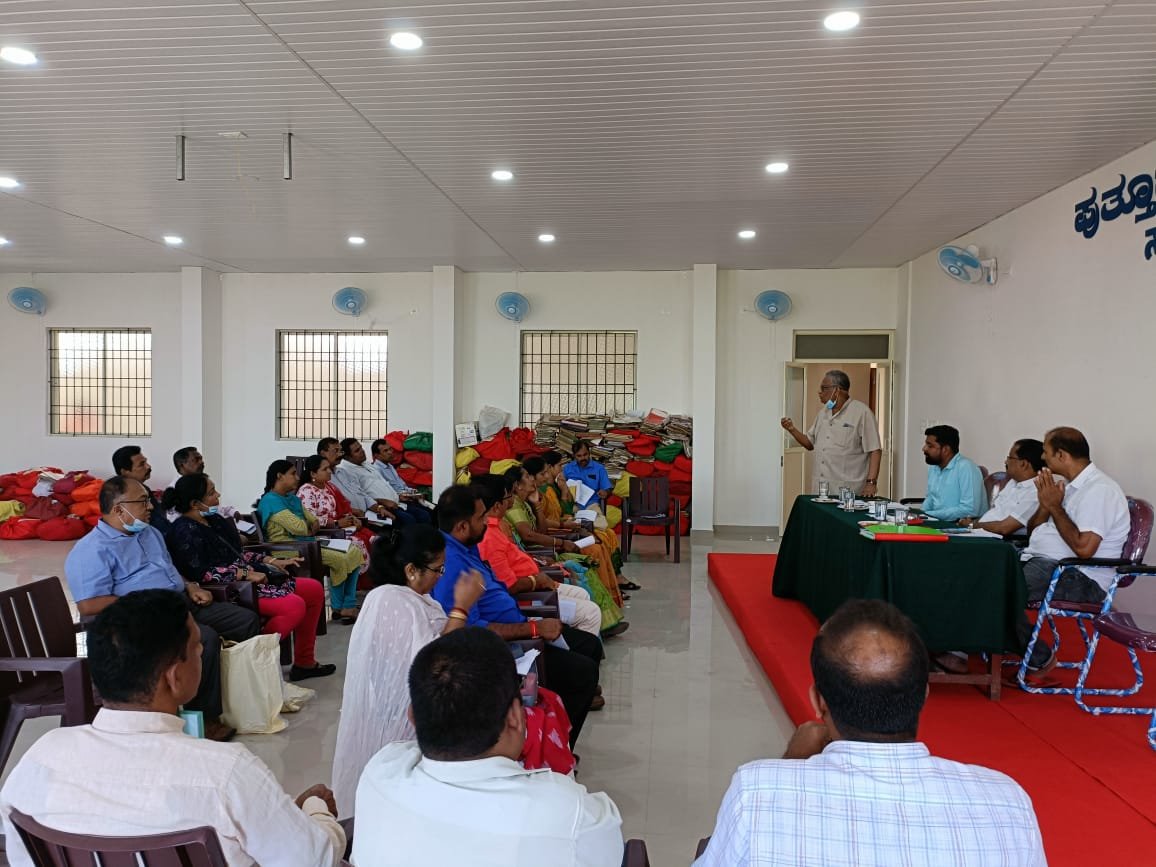
Civic technical presentation on municipal zero-water plastic valorization.
Directly view and download authenticated patent grants, statutory design registrations, and civic proposals.
Technical due diligence sessions, institutional presentations, and patent verification dossiers are available for industrial processors and civic authorities.
LIVE PLANT & TESTING DEMONSTRATION FOOTAGE
Direct video recordings from our manufacturing workshops demonstrating raw waste intake, continuous thermo-mechanical die extrusion, and high-impact structural testing.
READY TO DEPLOY THIS TECHNOLOGY IN YOUR REGION?
We license the patented process and engineer custom made machine solutions for entrepreneurs, municipal corporations, and industrial processors across India.